
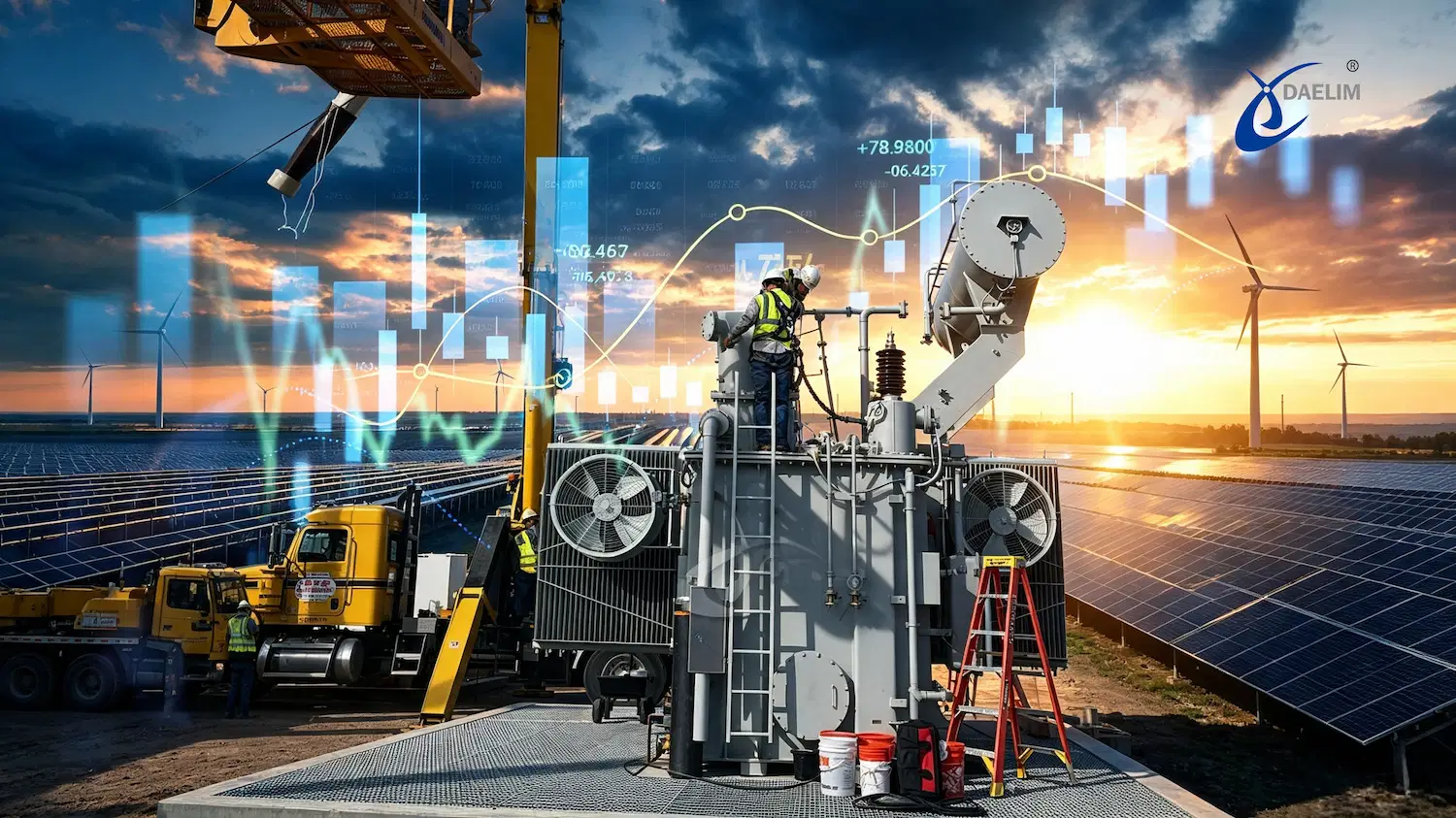
Global energy is facing different transformation levels. Based on climate objectives, fast technology advancement, and renewable energy developments, especially solar power, is working as the main source of modern electricity systems. Solar systems, especially for larger-scale farms, are making new innovations for electricity grids and also require new grid device installations.
The main components of installations are transformers that maintain voltage levels for easy power transmission and safe connection between the generation end and the grid. In this tutorial, we will cover details for solar farm growth in North America and Europe, affecting transformer demand and future trends. Let’s get started.
Solar Power Surge Transformers Catalyst
Solar Capacity Expansion in North America and Europe:
- The electrical system is being modified due to the fast growth of solar power in Europe and North America, with transformers as the main source for energy transformation.
- These continents are focusing on clean energy and decarbonization to reduce the use of fossil fuels and prevent the generation of greenhouse gases.
- For boosting larger-scale solar investments, different policies in the USA, such as the Inflation Reduction Act, give long-term tax grants and subsidies.
- Also, the European Green Deal and relevant renewable energy authorities want to expand renewable sources in EU countries until 2030, and after that
- Such policies cause regulatory confirmation and also financial support for IPPs, utilities, and other firms. For getting long-term policy support and good results, utility-scale solar farms are installed with distributed rooftop PV systems.
- So, installed solar capacity for different countries is increasing speedily, and can triple in a decade.
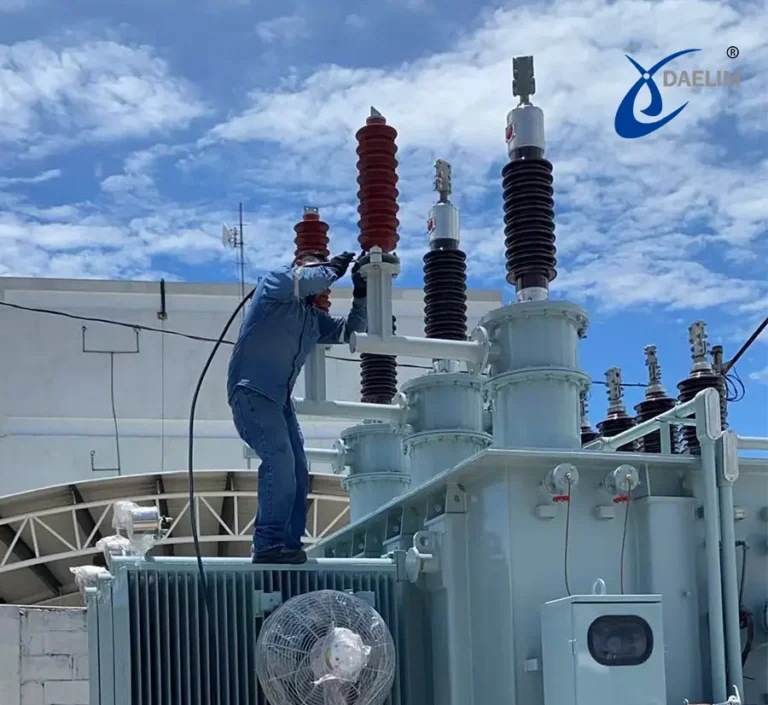
- Power is generated through a solar installation system connected with the grid, and this connection is made with a transformer.
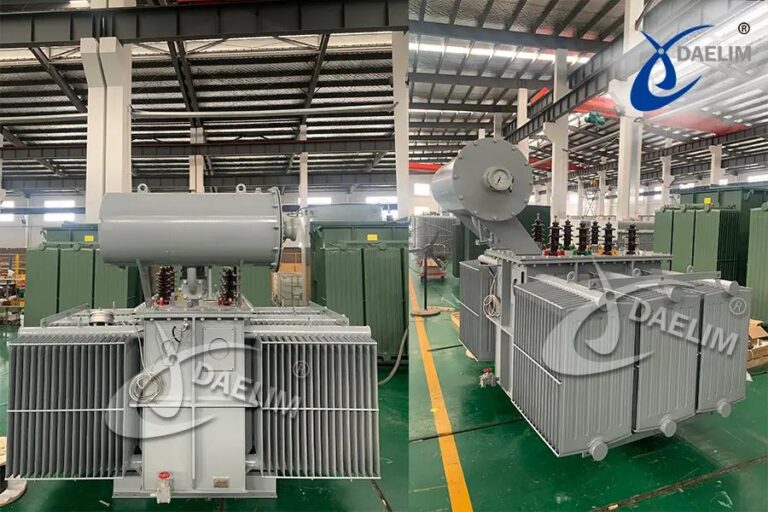
- With new and larger solar installations, transformer demand is also growing. So high-capacity power transformers are connected at solar installations and deliver power to the grid.
Why Solar Farms Use Transformers
- DC power is generated at the solar pv system, and the grid operates with AC power. So a transformer is an important device in solar power systems. Solar power generated is DC, first converted to AC, which is used for operating the grid. So a transformer is an important component in this conversion to deliver the grid after the step-up voltage.
- Step-down transformers are also used for some applications, especially when solar power is locally distributed, and for users’ loads.
- Transformers also provide isolation since they protect the grid structure and operators by providing separation between different parts of the system. It saves components from damage and makes the system efficient, especially in larger solar farms in different environmental conditions.
- Solar also maintains power quality. Solar output fluctuates due to variations in temperature, cloud cover, and daily solar cycles.
- So proper transformer designing methods makea stable voltage and reduce harmonic distortion.
Solar Transformer Market, Growth & Projections
Market Growth Rates and Size
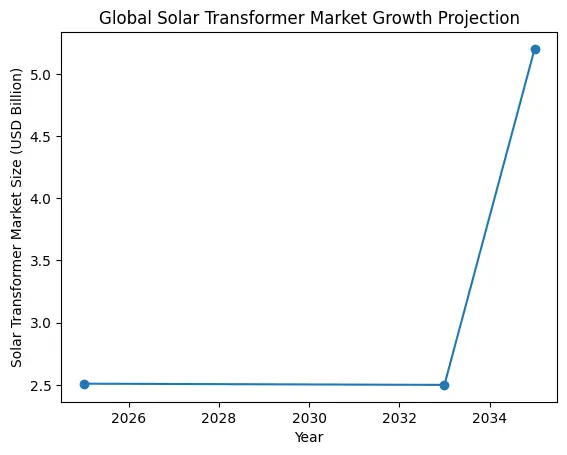
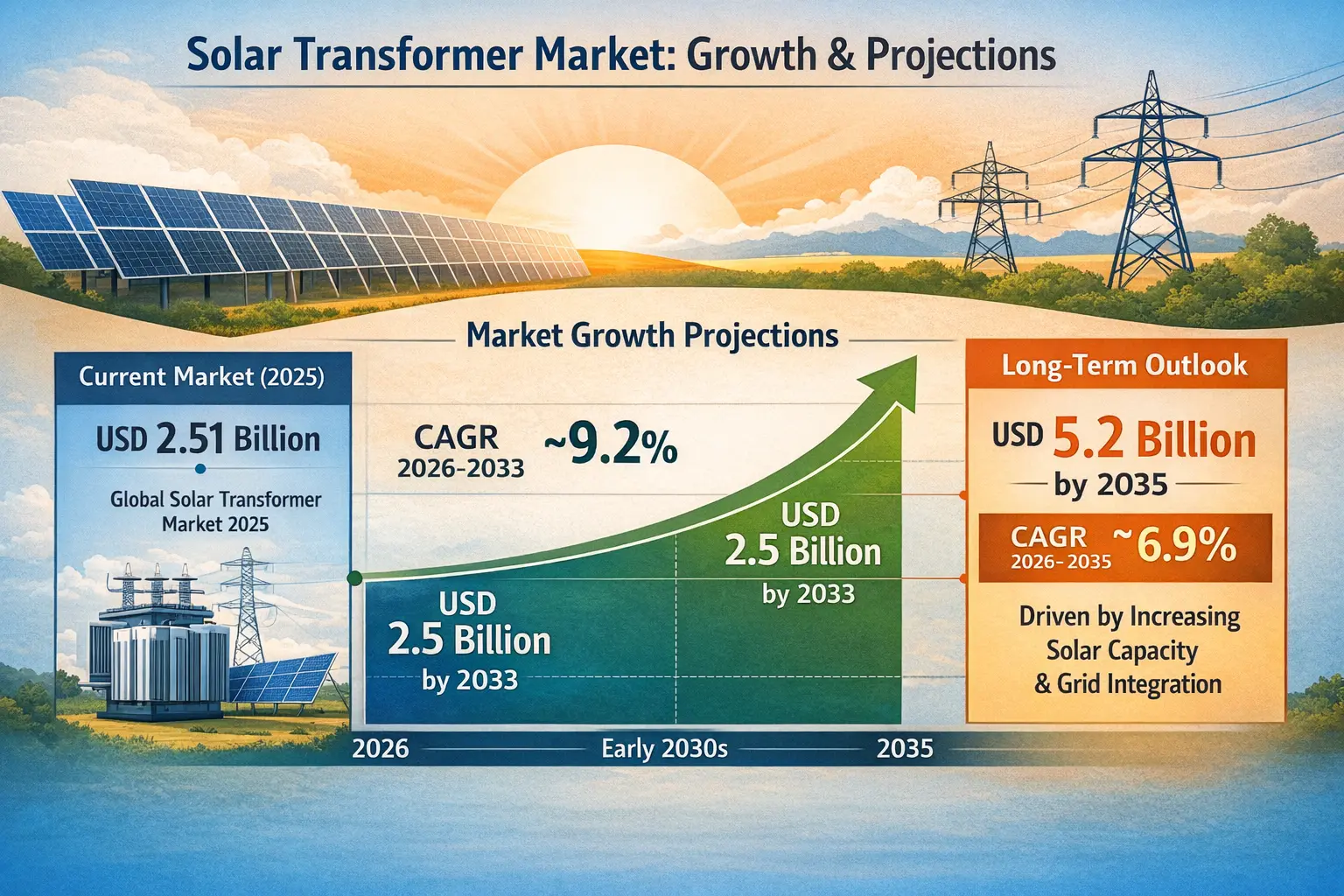
In 2025, 2.51 USD was the global solar transformer market that was using larger-scale solar power systems. But based on recent research, the solar transformer market is expanding fast into and beyond 2026, and projections show ongoing growth through the early 2030s.
It is estimated that the market will grow to about USD 2.5 billion by 2033 at a compound annual growth rate of about 9.2% from 2026 to 2033. According to other details, the solar transformer market will reach USD 5.2 billion by 2035 at a CAGR close to 6.9% over the broader 2026 to 2035 period. These predictions show increasing solar capacity, connection with the grid, and the best energy policies.
Different factors that affect growth are
- Solar power capacity all over the world
- Each country assigns special incentives and renewable energy favorable policies.
- Compatibility of advanced features with the grid and renewable energy
- Electrification of commercial sectors
Here is the graph showing the global solar transformer market growth (2025–2035)
Regional Market Contribution
- Solar transformers are a common and high-demand tool in North America for power transmission, with a market value of USD 850 millionthat are part of grid upgradation, larger solar farms, and soft government policies.
- With these favorable conditions and easy installation, it is estimated that the North American solar transformer market will reach USD 1.7 billion by 2035.
- Like North America, Europe also has a highly demanding market for solar transformers. since they are working for industrial electrification, preferring high renewable energy systems and high decarbonization targets.
- Friendly policy and larger grid interconnections maintain transformer demand in European countries.
Expert Opinions and Industry Context
Renewable Energy Compatibility as Primary Growth
Different industrial experts agree that the high demand for renewable energy resources for solar power is the main factor that increases transformer requirements. Solar and wind energy are rapidly increasing for global electrical power generation, and strong grid connection is becoming important. The transformer is the main component for converting and delivering renewable energy from generation to the load side. Market research shows that high use of renewables increases the use of system-level transformers and PV systems.
You may enjoy: Solar Transformer, Get The Best Price
Technological Advancements
Technological advancement is also the cause of the deployment of modern transformers. According to experts’ opinion, the main features of next-generation transformers are grid support, digital monitoring systems, and highly effective design.
With that new transformer technique, maintaining variations of renewable energy generation through stable voltage regulation and proper power supply, regardless of whether solar output varies. Advanced features of transformers are now important for complicated power systems.
Government Policies
supported government policies important for high market growth. such as carbon reduction targets, renewable portfolio measures, incentive programs, and electrification planning of economies, urging large-scale installation of solar energy projects.
These parameters control financial hurdles for developers and manage long-term structural development. So high solar installation enhances the demand for transformers that are important for grid compatibility and power delivery.
Experts focus on the proper regulatory support, which is important for maintaining investments and providing stable growth for the solar transformer market.
Solar Transformer Market Segment Trends
Utility-Scale Solar Farms (High-Voltage & Step-Up Transformers)
- The larger transformer market is expected to expand witha CAGR of ~6.9% from 2026 to 2035 and will become around USD 131.96 billion by 2035.
- Utility-scale high-voltage power transformers are important for increasing solar farm output voltage according to the transmission system; that is, the current rate is USD 17.6 billion in 2026and reaches USD 31.8 billion by 2035 (~6.1% CAGR).
- North America and the Asia Pacific have a high demand due to the targeting and installation of renewable energy grids.
Commercial Solar Installations (Distribution/Medium-Capacity Transformers)
- The distribution transformer market with medium-capacity models that are part of the commercial solar PV system will grow rapidly in the coming decade. It is expected that global distribution transformer revenue will shift from the current value of~USD 21.4 billion to USD 29.6 billion by 2030 at a CAGR of ~6.7%.
- Distribution transformer is part of the infrastructure system, commercial solar, and industries where their growth is increasing the Asia-Pacific share (~45%+),with growth rates in North America and Europe.
- Through 2030 and after that, a larger number of data centers and shopping centers will use solar plus storage and medium-capacity distribution units.
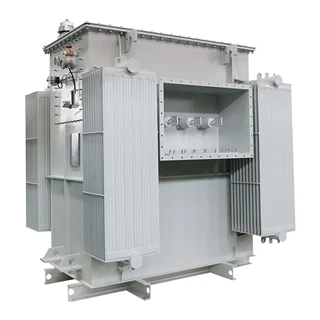
Residential Solar Installations (Low-Voltage & Step-Down Transformers)
- Residential rooftop PV growth and local distribution required a high demand for small, low-voltage/step-down transformers, with accurate valuations of the segment defined by larger distribution market numbers.
- In Europe and China, reducing solar panel costs and friendly residential solar policies are leading to high levels of rooftop installation and relevant transformer installations.
Market Size & CAGR (2026-2035)
| Segment | 2026 Estimate | 2035 Forecast | CAGR |
| Total Transformer Market | ~$28,9B (2026 est.) | ~$45.5B (2035) | ~5.2% |
| Global Transformers (Broad) | — | ~$131.96B (2035) | ~6.9% |
| Utility High-Voltage | ~$17.6B (2026) | ~$31.8B (2035) | ~6.1% |
| Distribution Transformers | ~$21.4B (2026) | ~$29.6B (2030) | ~6.7% |
High-Level Transformer Market Dynamics
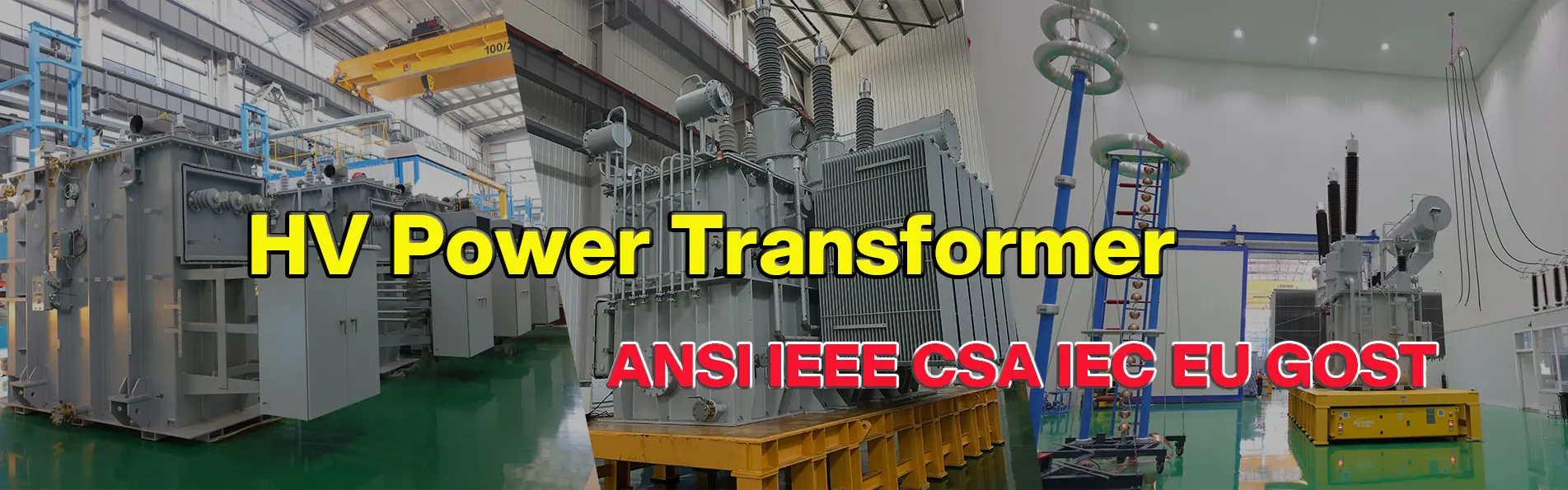
- Data shows the renewable energy transformer market is growing and adding to larger growth phases through different renewable techniques and grid modernization.
- Solar is the main source of power for decentralized systems, but wind energy is also needed to meet high transformer demand.
- In 2026, the market is estimated to be USD 17.1 billionand will become USD 23.92 billion by 2030, adding a strong CAGR of about 8.8%
- A high growth rate shows high investment in renewable energy infrastructure and complex design of power systems with advanced transformer solutions.
- The main observation from this data shows power transformers covering more than half of the net market.
- Large-scale renewable projects like solar parks and wind farms require high-rated transformers for step-up voltage to deliver over longer distances.
- These transformers are important for the connection of generation systems and regional grids.
- The distribution transformer is also facing high growth. Since the growth of rooftop solar installation requires these transformers for microgrids. Since power generation is decentralized and generated at the point where the load exists.
- So a distribution transformer is used for this energy localization while maintaining a low voltage level and bidirectional power flow between the storage system and the grid.
- Solid-state transformers are also growing as part of power electronics for high efficiency and fast voltage regulation with digital monitoring features.
Regional Highlights: North America
North America Power Transformer Market Overview
The North American power transformer market is strong, operated with grid-reliable features, modernization, and solar integration with other renewable sources.
According to current details, North America holds 20 to 21 percent of the global transformer market share, and the U.S. has high regional demand.
Regional Trends: Europe
European Transformer Market Growth
Europe also has high transformer growth for grid modernization and supporting renewables. According to different details, there are high compound growth rates, such as 3.8% to high 8.1%, for the market part, based on methods and scope.
In 2024, the European transformer market value was USD 11.5 billion, and it will double by 2034 through high electricity demand and system expansion.
Europe’s Demand Components
Green Energy Policy:
- Fitting in 55 packages and national renewable observations are EU regulations to employ long-term transformers.
Offshore project installations
- A special type of transformer employed at offshore wind farms that is configured with the main grid
Smart Grid connection
- The distribution generation system is handled with IoT and digital transformers in European utilities.
Transformer Market Challenges
Supply Chain Management
- There are different components like copper, quality steel, and insulation. So components must reach the given time without increasing lead time, which affects installation.
Shortage of skilled labor
- Skilled working staff is also important for proper assembly and making quality products. If skilled technicians are not on staff, you have an effect on delivery as well as generating capacity.
Regulatory difficulties
- If proper grid interconnection and permission are not obtained to manage environmental factors, it has effects on renewable projects and has a bad impact on unit procurement schedules.
Conclusion
In North America and Europe, the growth of solar farms is not only for panels and inverters but also highly affects the power system. Transformers are the main component since they are causing a world shift to installing renewable energy systems with solar-demanding transformers for maintaining loads, accurate power delivery, and stable grid function.
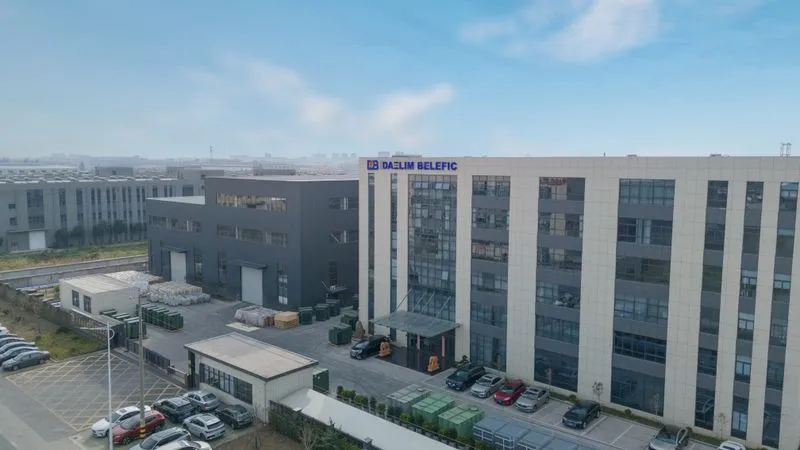
Daelim Transformer provides global renewable expansion support through constructing high-performance, project-based transformers that have easy connections to grid modernization and energy infrastructure projects. Contact our experts today to discuss your solar transformer requirements.
 English
 Polish
 German