
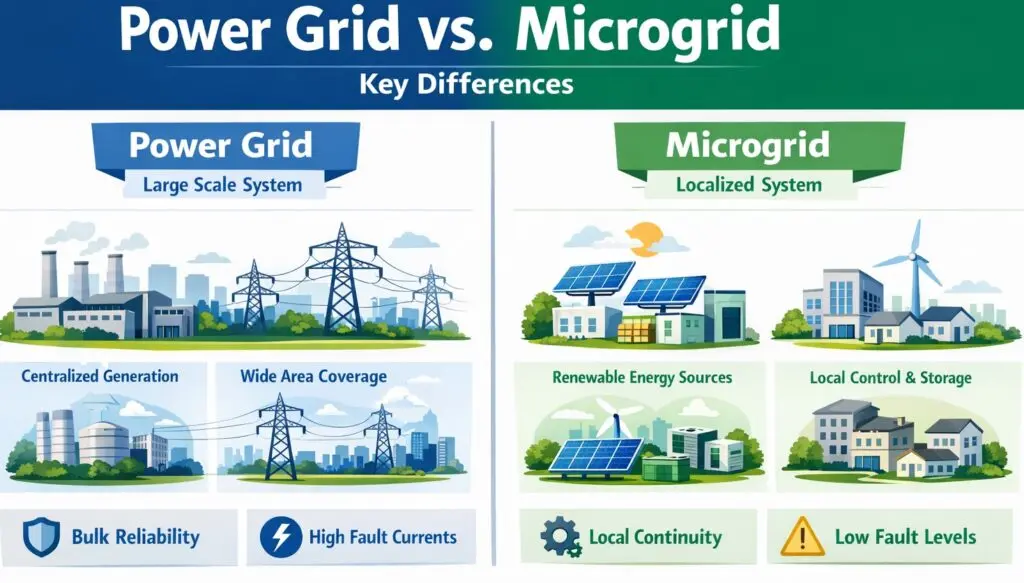
The advanced electrical system is rapidly evolving due to the distributed production of renewable energy and the introduction of advanced features that are transforming the design and operation of electrical power systems. Microgrids and conventional power grids both provide power, but they differ in structure and design. Their differences are not only about their dimensions but also in functional and system features.
In this post, we will detail a technical comparison between microgrids and utility power grids. Let’s get started.
Comparison——Microgrids: More Than Just Small Grids
Different Design
- Power grids are made for providing power to different geographic locations and making connections between different users and the transmission and distribution system. These systems provide a high-power, reliable way to, in other words, continue supply regardless of system requirements or any component not operating.
- While microgrids are different in design and have localized operating objectives. They deliver power to certain areas, like buildings, hospitals, military bases, etc. They do not maximize energy transfer for the region, but they do operate on power maintenance for different loads and manage local production and storage resources.
- In simple words, a power grid provides scale optimization, and microgrids perform control optimization.
Design objective: Bulk Reliability vs. Local Continuity
- Power grid operations are based on an interconnected system for providing reliable operations at diverse levels. If in system one, a generator is not operating, then power will be delivered from a different part of the system.
- Microgrids are not based on distant resources since they come with different reliable planning according to load supply, storage compatibility, and local control decisions; they also provide isolation when a disturbance occurs
System Boundaries
- Power grids owned and functioning through regulated utilities provide accurate separation between the production system, transmission, and distribution system.
- While microgrids are confined to users’ boundaries, those owned by certain organizations or institutions
- Integrated generation, loads, and controls under one authority
You may enjoty: Utility Transformer
System Topology and Network Structure
The electrical structure and topology of the power system help to find power flow faults and stability of the system when any faults occur.
Power Grid
Radial and Meshed Distribution System
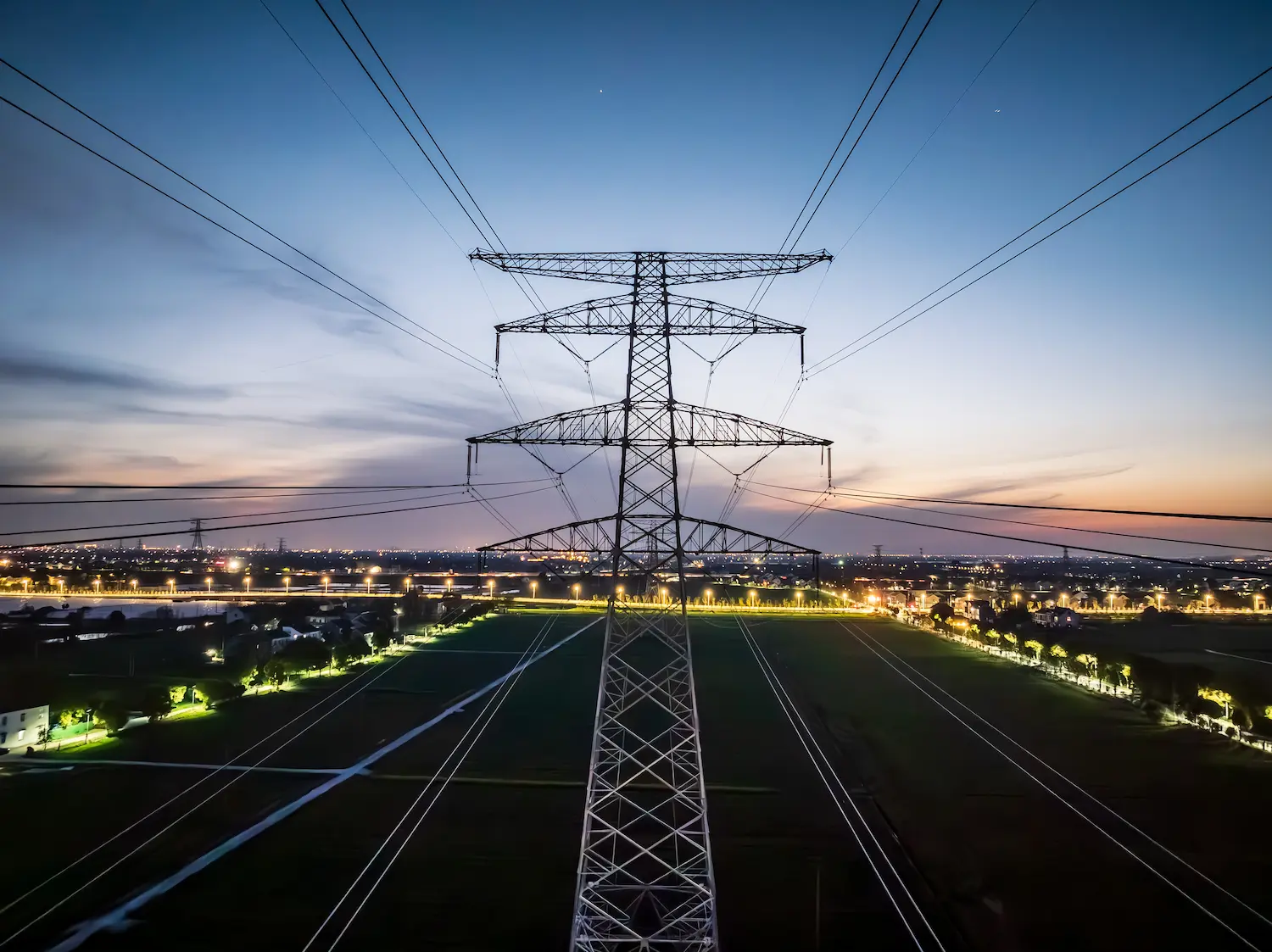
- Power grids are designed through radial or meshed designs. For radial systems, power flows from substations to feeders for customers. That design makes simple functions and protection operations.
- For a meshed system, different interconnections between feeders cause power flow at different paths if a single line is not operating.
- These paths’ interconnection is important for a reliable system since it delivers power when faults occur.
Get it free: Guide to Transformer Failures
Large Area Coverage
- Power grids over a larger area, spanning from one city to another country. Power generated at larger plants and delivered at longer distances before being accepted by a distribution system
- In this larger-scale operation, different generators operate simultaneously, load variations are equally shared in the complete system, and local disturbances restrict the complete impact.
High Short-Circuit Strength
- If faults occur at the power grid, a different generator manages the fault current at the same time. As a result, high short-circuit current levels occur, providing easy fault detection with protection devices and high voltage recovery when the fault is cleared.
Microgrid
Compact Systems
- Microgrids are operated under certain electrical restrictions, like building and industries. production point and loads are located near each other.
- This compact design shows the use of fewer feeders, restricted interconnections, and localized power flow.
Short Feeder Lengths
- Small distribution lines minimize power losses with varying dynamics of the system. Faults easily propagate over the system, voltage variations instantly occur, and it comes with lower natural dampening than large grids.
Reduced Fault Levels and System Stiffness
Microgrids employ inverter-operating devices like solar PV battery storage. Inverters limit fault current for the protection of electronic components.
As a result, fault currents are of less value, protection systems are highly sensitive, and the electrical system is weak, which causes easy disturbance of voltage and frequency.
Engineering Implications
Low X/R Ratio and Stability factor
The X/R ratio defines the relation between the reactance and resistance of the system. A power grid comes with a high X/R ratio since it has transmission lines of inductive materials. While microgrids come with low x/r ratios due to short cables, and resistance is high.
Low value of X/R ratios resulting in high-speed voltage variations, low natural damping with high sensitivity for load switching, and inverter control processes.
Reduced Inertia
- A larger-sized power grid comes with a rotating generator for storing kinetic energy. Inertia defines low-frequency variations when any abrupt variation occurs.
Microgrids do not come with any rotating generator that results in frequency changes fast; controllers should respond instantly.
Stability based on the control process compared to mechanical energy.
Voltage Drops and Impedance Sensitivity
For microgrids, minor impedance variations highly affect voltage since this system is electrically small. As a result, high voltage variation occurs when the load varies.
High demand for coordinated voltage regulation and high sensitivity for cable length and sizing conductor
Control Systems and Operational Hierarchy
Power Grid Control
Larger power grids are operated with multi-layered control operations where decision-making is applied over different supervisory levels.
Energy Management System (EMS)
The energy management system operated with a high operational level. Its main objective is proper planning and system optimization. Its main features are
- Scheduling and dispatching of generation, and low-cost power plant operations
- Maintain system balance for production and demand
- Generation scheduling and dispatch
Keep reading:What Transformers Are Using In power plant?
Distribution Management System
This system manages mid- and low-voltage distribution systems closer to users. Its main features include voltage regulation, loss minimization, outage management and restoration, and feeder redesign.
SCADA
- SCADA provides real-time monitoring and control, including remote switching and device control, continuous monitoring of voltage, current, and power flow, and alarm monitoring. SCADA helps control center operators monitor and manage the grid instantly.
Microgrid Control
Microgrid Controller (MGC)
- The main component of a microgrid is the microgrid controller that manages distributed energy sources, storage, and load. The design of MGC comes with
Centralized:
- A single controller is used as a decision maker for the system.
Distributed:
- Different controllers manage operations for generators and devices.
Hybrid:
- Collaborate with central supervision and local autonomous control.
Control Levels in Microgrids
Primary Control, Instantaneous Stabilization
It is high-speed control layers that provide constant voltage frequency when any fault occurs.
It employs inverter control loops and operates automatically within milliseconds.
Basic control avoids system damage when abrupt load variations occur.
Secondary Control, Restoration
When stability occurs, secondary control restores different factors at nominal values. that involved the correctness of frequency variations and the set voltage to the set point.
Many different generators, and this layer operates for seconds to minutes according to requirements
Tertiary Control, Optimization, and Power Management
High microgrid control level operated on efficiency through dispatching generators and batteries. It manages energy costs and controls power exchange with the utility grid.
Tertiary control defines import or export power.
Frequency and Voltage Regulation System
Traditional Power Grid Regulation
Power grids function through rotating synchronous machines like steam turbines, gas turbines, and hydro generators. These machines provide stable features for the system.
Mechanical Inertia from Turbines
A larger generator comes with high-weight rotating masses. If any fault occurs, like increases in load or generator losses, the stored kinetic energy of the rotating rotor provides resistance for frequency variations. that naturally manage, slow the frequency changes, give time for the control system to respond, and provide system stability. This feature is known as system inertia.
Governor Response for Frequency Stabilization
The turbine comes with a speed governor that sets the mechanical input power. So, through frequency losses, the governor enhances fuel or water input. Generator output power increases, frequency returned at nominal value.
With increases in frequency, mechanical input reduces. So this balance maintains generation and load matching over the grid.
Strong Voltage Regulation
Power grids come with high fault current features since different generators are connected. This makes a strong electrical system, where the voltage is stable, and the load varies.
Voltage controlled with a generator excitation system, tap changer of the transformer. through reactive power compensator devices
Microgrid Regulation
Minimal Mechanical Inertia
The inverter does not come with a rotating mass configured with grid frequency. So no natural kinetic energy buffer exists. Frequency varies fast when the fault is finished.
stability features based on electronic control compared to physics
Droop Control features
- For managing generator operations, droop control is used where frequency reduces with increases in active power. Voltage reduces as reactive power output increases.
Which helps different inverters share a load without a direct connection as a synchronous generator
Virtual Inertia Algorithms
- An advanced controller resulting in virtual inertia with inverter programming for responding to frequency changes, since it comes with rotating mass. Inverters temporarily add or absorb power for slow frequency variations, increase the stability of transients, and are compatible with islanded operation.
Protection Schemes and Fault Management
Utility System Protection
A conventional utility distribution system made with predictable power flow and high-strength fault current
Time–Current Coordination
- Utility protection employs time-current collaboration. Protective devices like reclosers, relays, and fuses are configured. So devices close fault functions first.
- If downstream protection does not work on upstream devices, then it operates.
Predictable Unidirectional Fault Currents
- For conventional grids, power moves from a larger central generator to load. When a fault occurs, current follows a single direction. The fault current value is high due to synchronous generators.
- Protection devices cause differentiation in faults from normal functions.
Microgrid Protection
Bidirectional Power Flow
For microgrids, power flows in different paths since solar, batteries, and local generators deliver power to neighboring loads.
Energy also moves back to utility grids.
When a fault occurs, the current direction is difficult to predict. Conventional protection schemes made for one-way power movement can cause tripping.
Microgrids Engineering Challenges
Relay Settings
- Microgrids operate with different configurations.
- grid-connected mode, islanded mode, different generations configuration
- Protection settings should be automatically applied for variation system conditions. The relay needed a different setting that switches according to the operation mode.
Communication-Assisted Protection
- Local calculations can be ineffective for microgrids based on the communications of devices. like differential protection systems, directional relaying, and controller-assisted tripping decisions
- Communications increases selectivity by adding dependency for data links.
Faster Fault Detection Requirements
Microgrids have low inertia and small electrical dimensions, which cause fast-spreading disturbances. So a protection system is important for detecting faults quickly and clearing faults at high speed compared to conventional grids.
It avoids system damage for islanded operation.
Load Modeling and Demand Characteristics
Power grid load modeling
Utility planning is defined through different features. A larger power grid delivers a supply to different users throughout the day. since not all users use the highest power at the same time.
so total system requirements are predictable, and peak demand is less than the total of individual maximum loads.
Microgrid Load Classification
Microgrids deliver power to limited loads within certain limits. Compared to focusing on average statistics, load should be defined based on functional features.
Critical Loads
These loads also remain powered during outages, like medical tools, hospitals, data centers, and industrial safety systems.
Non-Critical Loads
These loads were temporarily disconnected from the stable system for limited production. such as HVAC systems, auxiliary industrial processes, and unimportant lights.
Reliability Metrics and Performance Evaluation
Reliability Measurement in Power Grids
SAIDI: System Average Interruption Duration Index
- SAIDI measures the average net outage time that users face for a certain time, normally for a single year. It shows that users do not have power, and fewer SAIDI values provide a good system.
SAIFI: System Average Interruption Frequency Index
- SAIFI is used to measure the average user experience during power interruptions. It shows outage frequency and helps utilities measure system operations and efficiency for maintenance.
CAIDI: Customer Average Interruption Duration Index
- CAIDI shows the average restoration time for a single outage occurrence.
- It is used to measure the SAIDI divided by SAIFI. It defines how fast utilities restore service when a failure occurs.
Microgrids Performance Evaluation
Critical load continuity
- For the microgrid’s main operations, the important system is in operation. Like hospitals, data centers, and industries continue to function even if non-critical loads are connected.
Event Resilience
Microgrid working is evaluated when certain faults occur. like utility grid outages, bad weather conditions, and device faults.
Features for isolating and continuing functions as an important indicator factor.
Recovery Speed During Disturbances
Another important factor for the fast stability of the system after faults is the transition time for islanded operations, frequency and voltage recovery, and disconnected loads restoration
Power Quality and Harmonic Management
Harmonic Behavior in Large Power Grids
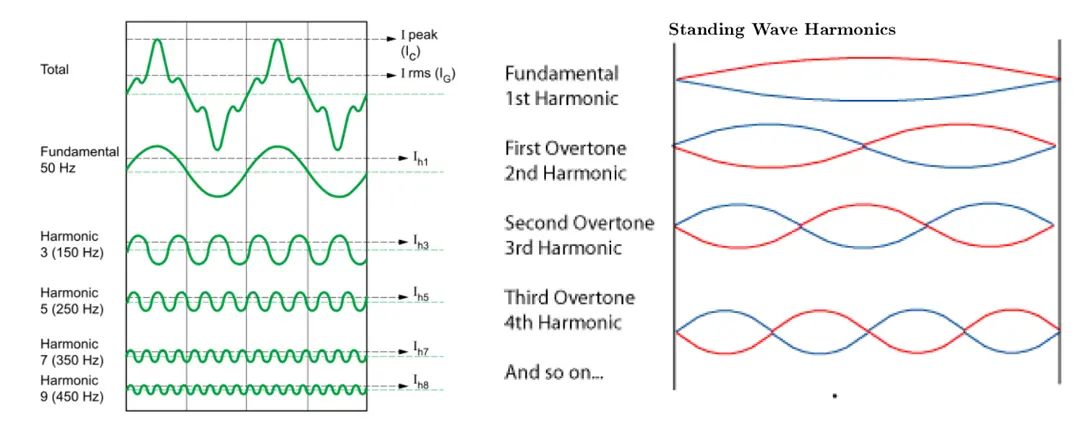
Large interconnected power grids minimize harmonics due to size and electrical features. The main causes are different generators and loads connected over different locations.
High short-circuit features cause the system to become electrically stiff. Harmonic current falsely spreads over the system, more than concentrating at single locations.
So, voltage distortion is less, and nonlinear loads have a low system impact. Power quality faults are easy to manage.
You may enjoy: Guide to Transformer Harmonics and K-Factor
Challenges for fulfilling IEEE 519 Harmonic Limitations
IEEE 519 provides limits for harmonic distortion to protect devices and provide safe functions. Maintaining these limits becomes difficult for microgrids. since fault levels provide low voltage distortion. The inverter switch inserts harmonic components.
Interconnection and Regulatory Factors
- If the microgrid functions over a utility power system, it does not operate independently without fulfilling technical factors and regular demand. These rules are used to offer safety factors and make a stable grid, and avoid faults from spreading further. So interconnection regulations affect microgrid design and operations.
Interconnection Standards
- Interconnection standards explain the technical factors that microgrids use to make connections with the utility grid. These standards are. accurate voltage synchronization, frequency, and phase angle before the connection phase.
- Safe switching and disconnection process.
- Compliance with power quality and protection coordination through utility equipment
Anti-Islanding Protection
- The main safety feature is anti-islanding protection. Islanding results when some part of the system continues operating after a mistaken disconnection from the main utility supply. that conditions become hazardous. since
- Utility operators can result in lines being deenergized. voltage and frequency drift to safe limits. Equipment can be damaged.
- Anti-islanding circuits detect grid connection losses.
Utility Limits on Fault Contribution and Power Export
Fault Current Contribution Limits
Utilities restrict fault current for microgrids, which have features to add when a fault occurs to avoid pressure on protection devices. that results in generator sizing, inverter design, and protection system design
Export capability limits
Utilities can limit the power of a microgrid to send back to the grid due to high export.
Resulting voltage increases on feeders, reverse protection coordination, and overload distribution devices’
Effect on microgrid design and layout
These regulatory constraints affect the design of the system, with that extra protection device needed. The control system makes collaborations with utility features.
Operational flexible features are restricted to grid-connected operation.
Scalability and System Expansion Limit
The power grid’s scalability
- Utility grids are made by starting to support longer-term growth. Their design comes with planning margins, and redundancy offers new loads, feeders, and generators to connect without basic system functions. The main features are
- different substations and feeders interconnected. Extra capacity was added to the transmission and distribution system.
Microgrid Nonlinear Complexity Growth
- Microgrid functions differ, like new generation sources and added storage systems; system complications increase disproportionately rather than linearly.
- Small microgrids are easy to manage, but expansions offer new electrical features like different power flow paths, high inverter collaboration demand, and different fault behavior.
Protection Redesign After Expansion
- For utility grids, protection settings work for a longer time. While in micorgrids expansion needed protection assessment since.
- Fault current level varies, and the direction of power flow reverses. Existing relay collaborations do not work anymore.
Closing Technical Perspective
Complementary Roles in Power Systems
Utility power grids are optimized to operate in large-scale energy production and transmission. Regional reliability with interconnection and an effective bulk power supply for longer distances.
While microgrids operate for local control and operational flexible features. collaboration of distributed energy sources closest to the load and work well when an outage occurs.
Engineering Decisions by Practical Factors
- System design is based on technical features rather than technological factors. The main factors include electrical stability constraints and site-specific operational requirements, which require a reliable level of performance.
Conclusion
The main differences between microgrids and conventional power grids are based on operational design, protection systems, and reliable operations rather than only their sizes. Microgrids are important components in advanced energy systems, enhancing resilience, offering connections to renewable energy, and being compatible with decentralizing power supply.
Than replacing utility grids, it increases system flexibility and stable behavior. Microgrids are an important part of advanced energy systems since they offer resilience, offer high connection with renewable energy sources, and are compatible with decentralized power supply. Their features to work in grid-connected and islanded modes help loads to be energized when a fault occurs or the upstream grid is damaged, increasing system’s reliable behavior and operational features.

For advanced transformer solutions, grid collaboration compatibility, and electrical device services supported by utility and distributed energy projects, Daelim Transformer offers transformer-based equipment for both microgrids and power grids through manufacturing, installation, and longer working life solutions in modern power systems.
FAQS
How Do Microgrids Contribute to Energy Sustainability?
Microgrids provide energy sustainability through collaboration with renewable energy sources like solar and wind, minimize dependency on fossil fuels, and reduce greenhouse gas emissions. It increases efficiency through producing power at a local level, reduces losses during transmission, and uses storage for balance requirements that make the grid highly resilient.
 English
 Polish
 German